Customized Elevators

What is a Fork-Type Continuous Vertical Conveyor?

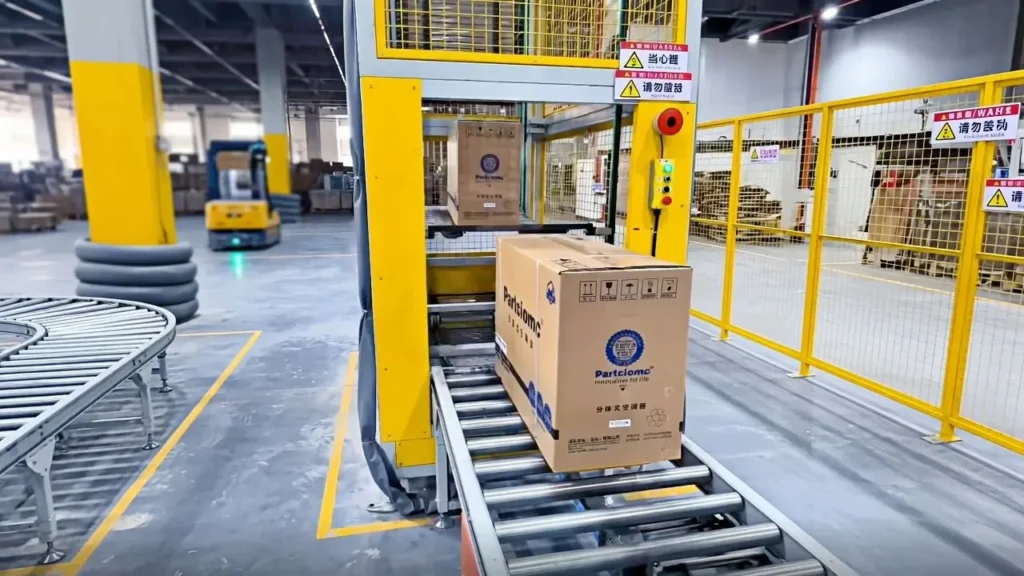
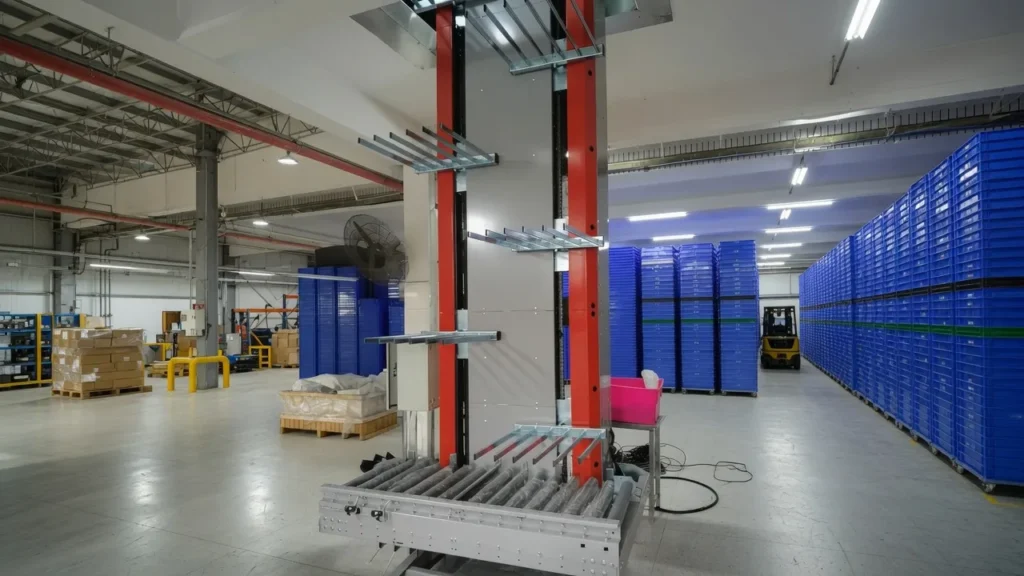
A Fork-Type continuous vertical conveyor (CVC) is a vertical lifting system that utilizes multiple fork-style product platforms running in a continuous loop. Driven by a closed-loop chain transmission, it enables uninterrupted, bi-directional vertical transport without needing to stop. This system is ideally suited for high-frequency, multi-floor material handling of light-to-medium loads (up to 80 kg). Compared to traditional reciprocating vertical reciprocating conveyors (VRCs), it offers significantly higher throughput capacity and continuous flow

Fork-Type Continuous Vertical Conveyor application restrictions
• Maximum cargo size limit:≤800mm*800mm*800mm;
• Maximum weight of goods:≤80kg;
• Type of entrance and exit:1 entrance and 1 exit/1 entrance, multiple exits/Multiple entrances and one exit;
• Entrance and exit directions:Vertical access/horizontal access;
• Note: The device can be reversed in both forward and reverse
directions.


A One-Stop Solution for Innovative Hoisting Equipment, Serving Global Industries

Fork-Type Continuous Vertical Conveyors (CVCs)

Fork-type continuous vertical conveyors are critical components in automated smart factories and distribution centers, particularly within the following industries:

E-Commerce & Express Parcel Hubs: Used for the rapid transfer of sorting bins, totes, and cross-docked parcels between multi-tier mezzanines.

3C Electronics Manufacturing: Ideal for transporting delicate components, high-value electronics, or finished goods between assembly floors.

Food & Beverage / Pharmaceuticals: Used to move uniform plastic crates, cartoned beverages, or pharmaceutical batches into elevated, temperature-controlled storage zones.

Chemicals & Coatings: Engineered to handle heavy, uniform payloads such as industrial pails, buckets, or drum-packed goods.

While these systems can be custom-engineered to meet a facility’s exact specifications, standard light-to-medium-duty units typically operate within the following thresholds:

Maximum Load Capacity: Generally optimized for light-to-medium freight, typically maxing out at 80 kg (approx. 175 lbs).

Maximum Product Dimensions: Most standard units accommodate medium-sized footprints up to 800 mm × 800 mm × 800 mm (approx. 31.5″ × 31.5″ × 31.5″).

Safety & Regulatory Profile: Because these systems are fully automated material-handling devices and strictly restricted from carrying passengers, they are classified as non-passenger, non-elevator equipment under most local codes. Consequently, they typically bypass the rigid, costly annual safety inspections and certifications required for traditional industrial freight elevators.

Single-Column Vertical Reciprocating Conveyor(VRC)

A Single-Column Vertical Reciprocating Conveyor, commonly known as a Single-Column VRC, is a robust and space-efficient vertical lifting system designed to transport palletized or heavy loads between multiple floor levels in warehouses, manufacturing facilities, and distribution centers.
Unlike continuous vertical conveyors, the Single-Column VRC operates on a reciprocating (up-and-down) principle. It features a single structural column with an integrated carriage platform that moves along guided rails. it to safely raise and lower loads with high precision.

Technical Specifications & Classifications
Our continuous vertical conveyors are categorized into three distinct classes based on payload capacity, each optimized for specific facility layouts and performance metrics:

1. Light-Duty Systems (Lightweight)

Engineered for high-speed, high-frequency transport of lightweight goods.

Maximum Payload: Up to 80 kg (approx. 175 lbs)

Maximum Vertical Travel (Stroke): 22 m (approx. 72 ft)

Lifting Speed: Up to 40 m/min (approx. 131 ft/min)

Leveling Accuracy (Error): Within ±3 mm (approx. ±0.12 inches)

Z-Flow Continuous Vertical Conveyor(CVC)

A Z-Flow Continuous Vertical Conveyor is a high-efficiency vertical conveying system designed to move products upward or downward between multiple floor levels in a smooth, continuous, non-stop operation.
The system gets its name from the characteristic “Z” pattern of the product path: loads enter horizontally at the infeed, travel vertically on specialized platforms or cleated belts, and then exit horizontally at the discharge level. This design enables gentle product handling while delivering significantly higher throughput than traditional reciprocating vertical lifts.

Key Benefits:
True continuous flow, eliminating start-stop cycles
High throughput — typically 15+ items per minute, depending on product size and system height
Compact footprint compared to inclined conveyors or multiple elevators
Excellent for cartons, totes, cases, trays, and other regularly shaped packages
Can be configured for both upward and downward transport within the same unit

Z-Flow CVCs are commonly used in distribution centers, e-commerce fulfillment operations, manufacturing plants, and packaging lines where consistent, high-volume vertical movement is essential. They provide a reliable, space-saving, and energy-efficient solution for multi-level material flow.

Vertical Reciprocating Conveyor with Enclosed Carriage

Vertical Reciprocating Conveyor with Enclosed Carriage
A Vertical Reciprocating Conveyor (VRC) with Enclosed Carriage is a fully guarded vertical lift system designed to safely transport palletized loads, carts, totes, or heavy materials between multiple floor levels in warehouses, manufacturing plants, and distribution centers.
Unlike open-platform VRCs, this model features a fully enclosed carriage (also called a “cab” or “shuttle”), typically constructed with expanded metal, sheet metal, or mesh panels on all sides, along with high-security gates at each loading/unloading level. The enclosure provides superior operator safety and protects the load during transport.

Enclosed Carriage: Fully guarded on all four sides with interlocked safety gates that prevent operation unless gates are closed.

Drive System: Usually hydraulic cylinder or heavy-duty chain-driven, capable of handling loads from 2,000 lbs up to 10,000+ lbs (900–4,500+ kg).

Multi-Level Capability: Can service 2 to 6+ floor levels with precise stopping accuracy.

Safety Compliance: Designed and manufactured to meet or exceed ANSI/ASME B20.1 safety standards for vertical reciprocating conveyors.

Indexing Vertical Conveyor

An Indexing Vertical Conveyor is a specialized vertical lifting system designed to move products between different floor levels in a controlled, stop-and-go (intermittent) motion, rather than continuous flow.

Unlike continuous vertical conveyors that run nonstop, an Indexing Vertical Conveyor pauses at each level to precisely load or unload products. This “indexing” motion allows for accurate positioning, making it ideal for applications that require synchronization with upstream or downstream equipment, such as automated production lines, robotic loading/unloading, or precise accumulation.

Key Features:
Intermittent Indexing Motion: The conveyor stops at each floor level for loading or unloading, then moves to the next position.
High Positioning Accuracy: Excellent for applications needing precise alignment with conveyors, robots, or packaging machines.
Flexible Load Handling: Suitable for boxes, totes, trays, pallets, and other unit loads.
Drive Systems: Typically powered by servo motors, AC motors with encoders, or pneumatic systems for precise control.
Safety & Protection: Often equipped with full guarding, light curtains, and interlocked gates.

4-Post Vertical Reciprocating Conveyor

A 4-Post Vertical Reciprocating Conveyor, also known as a Four-Post VRC
Four-Post Construction: Offers superior stability and minimal deflection, even with off-center or uneven loads.
High Load Capacity: Commonly handles 4,000 to 15,000+ lbs (1,800 – 6,800+ kg), with custom designs going even higher.
Large Platform Sizes: Can accommodate full-size pallets, industrial carts, racks, or bulky equipment.
Multi-Level Service: Can stop at 2 to 8+ floor levels with precise leveling.

Common Applications:
Moving palletized goods in multi-story warehouses
Heavy machinery or equipment transport between production floors
Automotive and aerospace parts handling
Distribution centers with high load requirements
Facilities needing to move large carts or containers vertically
Advantages:
Excellent stability for heavy and oversized loads
Highly customizable platform sizes and configurations
Superior safety and durability for demanding industrial environments
Better load distribution than single- or two-post designs

Stepping Lift

Upholding a philosophy of pursuing excellence, Jizhi Intelligent Equipment has established itself as a professional and reliable manufacturer.

With a global perspective, we stay at the forefront of international technology, dedicated to empowering the global manufacturing industry. Leveraging efficient supply chain management, international-standard quality certifications, and a comprehensive after-sales service network, Zhichi Intelligent is earning the trust and long-term partnership of an ever-growing number of overseas clients.

Four-Column Lift

Upholding a philosophy of pursuing excellence, Jizhi Intelligent Equipment has established itself as a professional and reliable manufacturer.

With a global perspective, we stay at the forefront of international technology, dedicated to empowering the global manufacturing industry. Leveraging efficient supply chain management, international-standard quality certifications, and a comprehensive after-sales service network, Zhichi Intelligent is earning the trust and long-term partnership of an ever-growing number of overseas clients.

E-Type Continuous Lift

Upholding a philosophy of pursuing excellence, Jizhi Intelligent Equipment has established itself as a professional and reliable manufacturer.

With a global perspective, we stay at the forefront of international technology, dedicated to empowering the global manufacturing industry. Leveraging efficient supply chain management, international-standard quality certifications, and a comprehensive after-sales service network, Zhichi Intelligent is earning the trust and long-term partnership of an ever-growing number of overseas clients.

What are the advantages of hoists in the industrial sector?

Heavy-Duty Industrial Lifting Solutions

Space Optimization: The vertical 90-degree handling mode minimizes footprint, liberates vast vertical space, and comprehensively expands your factory’s potential.

Advantages of the Fork-Type Reciprocating Lift

The Fork-Type Reciprocating Lift (also known as a Fork-Type Vertical Conveyor) serves as a core piece of equipment in modern automated logistics systems and smart manufacturing facilities, facilitating the vertical transport of goods—such as totes, pallets, and cartons—between different floor levels. Its defining characteristic is the adoption of an “interlocking comb-tooth” fork-arm design; this unique mechanical structure endows it with unparalleled efficiency and stability compared to standard box-type vertical lifts.

Advantages of the Fork-Type Reciprocating Lift

The Fork-Type Reciprocating Lift (also known as a Fork-Type Vertical Conveyor) serves as a core piece of equipment in modern automated logistics systems and smart manufacturing facilities, facilitating the vertical transport of goods—such as totes, pallets, and cartons—between different floor levels. Its defining characteristic is the adoption of an “interlocking comb-tooth” fork-arm design; this unique mechanical structure endows it with unparalleled efficiency and stability compared to standard box-type vertical lifts.

Advantages of the Fork-Type Reciprocating Lift

The Fork-Type Reciprocating Lift (also known as a Fork-Type Vertical Conveyor) serves as a core piece of equipment in modern automated logistics systems and smart manufacturing facilities, facilitating the vertical transport of goods—such as totes, pallets, and cartons—between different floor levels. Its defining characteristic is the adoption of an “interlocking comb-tooth” fork-arm design; this unique mechanical structure endows it with unparalleled efficiency and stability compared to standard box-type vertical lifts.

Advantages of the Fork-Type Reciprocating Lift

The Fork-Type Reciprocating Lift (also known as a Fork-Type Vertical Conveyor) serves as a core piece of equipment in modern automated logistics systems and smart manufacturing facilities, facilitating the vertical transport of goods—such as totes, pallets, and cartons—between different floor levels. Its defining characteristic is the adoption of an “interlocking comb-tooth” fork-arm design; this unique mechanical structure endows it with unparalleled efficiency and stability compared to standard box-type vertical lifts.

Advantages of the Fork-Type Reciprocating Lift

The Fork-Type Reciprocating Lift (also known as a Fork-Type Vertical Conveyor) serves as a core piece of equipment in modern automated logistics systems and smart manufacturing facilities, facilitating the vertical transport of goods—such as totes, pallets, and cartons—between different floor levels. Its defining characteristic is the adoption of an “interlocking comb-tooth” fork-arm design; this unique mechanical structure endows it with unparalleled efficiency and stability compared to standard box-type vertical lifts.

Advantages of the Fork-Type Reciprocating Lift

The Fork-Type Reciprocating Lift (also known as a Fork-Type Vertical Conveyor) serves as a core piece of equipment in modern automated logistics systems and smart manufacturing facilities, facilitating the vertical transport of goods—such as totes, pallets, and cartons—between different floor levels. Its defining characteristic is the adoption of an “interlocking comb-tooth” fork-arm design; this unique mechanical structure endows it with unparalleled efficiency and stability compared to standard box-type vertical lifts.

Advantages of the Fork-Type Reciprocating Lift

The Fork-Type Reciprocating Lift (also known as a Fork-Type Vertical Conveyor) serves as a core piece of equipment in modern automated logistics systems and smart manufacturing facilities, facilitating the vertical transport of goods—such as totes, pallets, and cartons—between different floor levels. Its defining characteristic is the adoption of an “interlocking comb-tooth” fork-arm design; this unique mechanical structure endows it with unparalleled efficiency and stability compared to standard box-type vertical lifts.

Advantages of the Fork-Type Reciprocating Lift

The Fork-Type Reciprocating Lift (also known as a Fork-Type Vertical Conveyor) serves as a core piece of equipment in modern automated logistics systems and smart manufacturing facilities, facilitating the vertical transport of goods—such as totes, pallets, and cartons—between different floor levels. Its defining characteristic is the adoption of an “interlocking comb-tooth” fork-arm design; this unique mechanical structure endows it with unparalleled efficiency and stability compared to standard box-type vertical lifts.

Get Application Trends, Technical Support and More Detail Info

Dongguan Jichi Intelligent Equipment Co., Ltd. specializes in the research and development and manufacturing of non-standard vertical lifting machines, providing one-stop customized solutions for manufacturing enterprises, smart logistics and automation integrators.